

Views: 0 Author: Site Editor Publish Time: 2026-10-13 Origin: Site


The pharmaceutical and nutraceutical sectors are shifting toward liquid-filled capsules to improve bioavailability, mask harsh tastes, and handle poorly soluble active pharmaceutical ingredients (APIs). Standard powder-filling equipment fails when handling the physics of liquids. Using the wrong machinery leads to dosing inconsistencies, capsule leakage, shell degradation, and cross-contamination. Manual filling processes waste time and cause dosing errors that ruin production batches. Selecting the right equipment requires looking past basic throughput metrics. You must evaluate machinery based on fluid dynamics, sealing integrity, operational workflow, and regulatory compliance. This guide breaks down how to evaluate and implement a specialized Capsule Filling Machine to ensure flawless execution of complex liquid formulations.
Liquid formulations demand specialized dosing pumps and integrated sealing mechanisms (banding or micro-spray) to prevent leakage and oxidation.
Evaluating a capsule filling machine requires analyzing its ability to handle specific formulation parameters, including viscosity, temperature sensitivity, and suspension stability.
The choice between manual, semi-automatic, and fully automatic systems dictates not only production yield and efficiency but also the required level of operator expertise and environmental control.
Regulatory compliance (cGMP) in liquid filling hinges heavily on clean-in-place (CIP) capabilities, material traceability, and verifiable leak-testing protocols.
Table of Contents
Liquid dosing introduces complex fluid dynamics that powder fillers bypass entirely. Viscosity directly dictates dosing precision and equipment selection. Low-viscosity liquids act like water. They flow rapidly but carry a high risk of splashing out of the capsule body during high-speed machine indexing. This splashing contaminates the capsule rim, making a secure seal impossible. Operators must carefully calibrate the acceleration and deceleration of the indexing table to prevent fluid sloshing.
Conversely, high-viscosity liquids create stringing effects. As the dosing nozzle pulls away, a string of thick liquid trails behind, dragging formulation onto the exterior of the capsule shell and the machine tooling. This requires specialized shut-off nozzles that cleanly sever the fluid stream. Suspensions add another layer of mechanical difficulty. You must maintain perfect homogeneity during the entire filling process to ensure uniform API distribution. If the solid particles in a suspension settle at the bottom of the hopper, the dosing becomes erratic. Overcoming this requires continuous, engineered agitation directly within the fluid delivery system.
To manage complex suspensions effectively, operators follow a strict sequence:
Verify the agitator paddle design matches the specific gravity of the suspended particles.
Set the variable frequency drive (VFD) to maintain a constant RPM that prevents settling without introducing air bubbles.
Interlock the agitation system with the dosing cycle so the machine halts immediately if the mixer stops.
Conduct periodic draw-off tests during the run to verify API concentration remains uniform.
You must carefully analyze the interaction between your liquid matrices and the capsule materials. Standard hard gelatin capsules contain a specific moisture content, typically between 13% and 16%. When you fill them with highly hygroscopic liquids, the liquid pulls moisture directly from the gelatin matrix. This rapid moisture extraction leaves the gelatin shell brittle, causing it to shatter during subsequent blister packaging or transport.
Furthermore, certain liquid formulations contain aldehydes that trigger cross-linking in gelatin, rendering the capsule insoluble in the human digestive tract. To combat this, Hydroxypropyl Methylcellulose (HPMC) capsules are often required for specific formulations. HPMC capsules possess a much lower inherent moisture content and resist moisture transfer. Utilizing HPMC helps maintain the exact liquid volume and structural integrity of the capsule throughout its entire shelf life, regardless of the liquid's hygroscopic nature.
Capsule Material | Moisture Content | Best Suited For | Known Limitations |
|---|---|---|---|
Hard Gelatin | 13% - 16% | Oil-based liquids, non-hygroscopic formulations. | Prone to cross-linking with aldehydes; becomes brittle if moisture is extracted. |
HPMC (Vegetarian) | 4% - 6% | Hygroscopic liquids, moisture-sensitive APIs. | Slightly lower mechanical strength during high-speed machine separation. |
Pullulan | 10% - 12% | Oxygen-sensitive APIs requiring high barrier protection. | Higher material cost; strict environmental humidity controls required during filling. |
The compliance risks of leaking capsules on a production line are severe. A single leaking capsule can spill sticky liquid formulation across the mechanical tracks of the filling machine. This jams the indexing table, forces immediate machine shutdown, and often leads to complete batch rejection due to weight variations and contamination. The cleanup process destroys production schedules and inflates operational waste. Operators must constantly monitor the tooling stations for any signs of fluid buildup.
Beyond physical leakage, lipid-based liquids face oxidation risks. Exposure to ambient air during the filling process degrades sensitive APIs and causes oils to go rancid. To prevent lipid oxidation and API degradation, specialized machinery must incorporate nitrogen purging and hermetic sealing. Nitrogen purging displaces the oxygen inside the capsule body just milliseconds before the liquid is injected. Hermetic sealing then locks the nitrogen inside, creating a stable micro-environment that protects the formulation until it reaches the consumer.
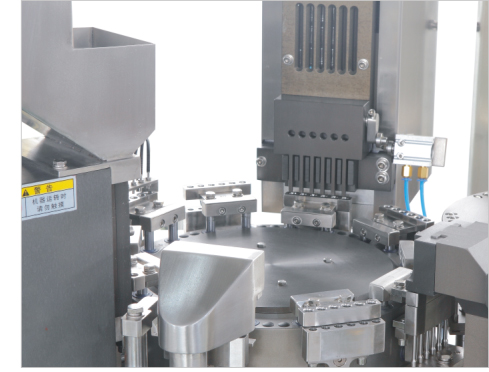
Understanding the fundamental mechanics of Liquid Capsule Filling Machines helps operators troubleshoot production issues on the floor. The process begins by loading empty capsules into the bulk capsule funnel and transferring the liquid formulation into the specialized heated or agitated hopper. The machine aligns the empty capsules and feeds them into the indexing table.
The automated sequence relies on precise mechanical timing:
Rectification: Empty capsules are aligned so all caps face upward.
Separation: A vacuum block applies negative pressure to pull the body down while the cap remains in the upper tooling block.
Detection: Optical sensors verify that the cap and body have successfully separated. If separation fails, the machine skips the dosing step for that specific pin.
Injection: The lower tooling block indexes under the dosing station. Precision nozzles descend into the capsule body and inject the exact volume of liquid.
Closing: The upper and lower tooling blocks align. Steel pins push the capsule body upward into the cap, locking the two halves together.
Ejection: The finished capsule is pushed out of the tooling and directed toward the sealing station.

Liquid capsule filling machines use different dosing pumps based on formulation viscosity and sensitivity. Ceramic valveless pumps suit low-to-medium viscosity liquids, peristaltic pumps provide gentle fluid handling, and servo-driven piston pumps support thicker formulations. Selecting the appropriate pump helps maintain dosing accuracy and protect product quality.
Capsule sealing and banding systems prevent leakage and improve product integrity. Banding applies a polymer layer around the capsule joint, while liquid sealing uses a compatible sealing solution to bond the cap and body. Both methods require validated sealing performance to ensure reliable storage and transportation.
Temperature control and agitation systems maintain consistent liquid viscosity and formulation uniformity during capsule filling. Heated hoppers and jacketed pipelines prevent waxes and oils from solidifying, while automated agitators keep suspended particles evenly distributed. These features help prevent dosing variations and material separation.
Semi-automatic liquid capsule filling machines combine mechanical dosing with manual capsule handling. They are suitable for formulation development, clinical trials, and small-batch production. Although they offer lower investment costs, production efficiency depends on operator involvement, and capsule sealing may require separate equipment.
Fully automatic liquid capsule filling machines integrate capsule orientation, separation, precision dosing, closing, and ejection into a continuous process. PLC controls and automated sensors help maintain filling consistency, detect defective capsules, and reduce manual intervention. These systems are suitable for high-volume pharmaceutical and nutraceutical production.
Hybrid capsule filling systems support specialized formulations combining liquids, powders, pellets, or smaller capsules within a single capsule. Multiple synchronized dosing stations allow manufacturers to produce complex dosage forms, including certain controlled-release formulations. Precise dosing and contamination control are essential for reliable operation.
Accurate liquid dosing depends on precision pumps, stable formulation viscosity, and reliable nozzle control. Automated checkweighing systems monitor capsule weights and reject products outside specified tolerances. Proper calibration and process monitoring help minimize material waste, reduce filling errors, and improve production yield.
Hygienic capsule filling equipment should feature suitable product-contact materials, smooth surfaces, and accessible fluid pathways. Optional CIP/WIP cleaning systems simplify cleaning and reduce manual disassembly. Validated cleaning procedures and appropriate equipment design help prevent microbial contamination and cross-contamination between production batches.
Modular capsule filling machines improve production flexibility by supporting different capsule sizes and formulations. Quick-release tooling, pre-aligned components, and clearly identified format parts help reduce changeover time and installation errors. Efficient changeovers improve equipment utilization and support multi-product manufacturing.
Operator training and documented SOPs are essential for consistent liquid capsule filling. Key procedures include environmental checks, pump calibration, nozzle inspection, vacuum verification, and trial runs. Proper training helps reduce operational errors, prevent material spills, and maintain reliable equipment performance.
Capsule leak testing verifies sealing integrity and helps prevent product leakage during storage and transportation. Suitable vacuum-based testing methods and automated visual inspection can identify weak seals, damaged capsules, or external liquid residue. Documented validation procedures support consistent product quality and regulatory compliance.
Temperature and humidity control help maintain capsule shell stability and consistent liquid viscosity. Excessively dry environments can increase static buildup and capsule brittleness, while high humidity may cause deformation and feeding problems. Appropriate HVAC and humidity management systems help ensure reliable filling accuracy and production efficiency.
Request detailed equipment specification sheets from manufacturers, ensuring they list 316L stainless steel contact parts and integrated CIP capabilities.
Schedule a live vendor demonstration using a placebo formulation that matches the exact viscosity and suspension characteristics of your most difficult liquid product.
Audit your facility's HVAC system to confirm it can maintain the strict 35% to 45% relative humidity required for handling empty capsules without deformation.
Draft preliminary Standard Operating Procedures (SOPs) for pump calibration and vacuum leak testing before the equipment arrives on the production floor.
A: No, retrofitting is highly discouraged. Standard machines lack the specialized fluid dynamics engineering required for liquids. They do not have valveless liquid pumps, heated hoppers, or shut-off nozzles to prevent dripping. Furthermore, standard machines lack the integrated banding or micro-spray sealing stations absolutely required to prevent liquid capsules from leaking after ejection.
A: Capsule banding applies an external, visible polymer band completely around the joint of the cap and body, providing strong tamper evidence. Capsule sealing uses a micro-spray of solvent applied to the joint, which uses capillary action and gentle heat to seamlessly fuse the cap and body together without adding an external layer.
A: High-viscosity formulations like pastes or waxes are handled using heated hoppers and jacketed transfer lines that keep the material warm and flowable. The machines also utilize specialized servo-driven piston pumps that provide the massive mechanical driving force necessary to push thick liquids through the nozzles without stalling.
A: The choice depends on the liquid. Gelatin is standard but contains 13-16% moisture, making it unsuitable for hygroscopic liquids that pull moisture and cause brittleness. HPMC capsules have low moisture (4-6%) and resist moisture transfer, making them superior for hygroscopic liquids and formulations prone to cross-linking.
A: Accuracy is maintained through precision ceramic valveless rotary pumps or servo-driven pistons that deliver exact volumes. Continuous fluid agitation in the hopper prevents suspensions from settling. Integrated inline check-weighing systems verify the mass of every single capsule, automatically rejecting any unit that falls outside the tolerance.
A: cGMP compliance requires all fluid contact parts to be made from 316L stainless steel to prevent corrosion. The machine must feature sanitary piping with zero dead legs to stop bacterial growth. It also requires verifiable Clean-in-Place (CIP) capabilities, strict material traceability, and automated data logging to maintain accurate batch records.
